Publication
Managing Parallel Criminal and Congressional Proceedings
By James P. Melendres, Andrew P. Young, Jason Spitalnick, Daniel C. Sale, Sam Crockett Neel, Aaron Shepard, and Christian Fernandez
With a new Congress taking office in January, many companies and individuals are preparing for letters, document requests, and hearings. Congressional investigations are often treated as solely political or reputational events, but they are also legal ones – with real criminal exposure. Committee document requests, subpoenas, transcribed interviews, and public hearings can produce a record that the Department of Justice (DOJ) later uses, and committees can refer witnesses and companies to DOJ for prosecution. Companies and individuals facing a congressional inquiry should therefore consider planning from the outset for the possibility of a parallel or follow-on criminal investigation, including one that could be initiated by a future presidential administration.
Five Ways Congressional Inquiries Create Criminal Exposure
- Referrals for substantive conduct. Congressional committees may refer the underlying conduct they uncover, such as fraud, bribery, antitrust violations, or sanctions violations, to DOJ. A referral does not bind DOJ, but it often prompts a preliminary review.
- Statements to Congress. Unsworn does not mean risk-free. False statements to Congress may be prosecuted under 18 U.S.C. § 1001, and false sworn testimony under the perjury statute, 18 U.S.C. § 1621. Section 1001 also applies to congressional investigations conducted under committee authority, so unsworn interviews and written submissions carry risk. A “successful” interview or hearing with a “friendly” majority on a committee in which the witness provides information that may be what the majority members want to hear can be scrutinized by the minority for potential false statements and referral to DOJ.
- Obstruction. 18 U.S.C. § 1505 criminalizes obstructing, impeding, or influencing pending proceedings before congressional committees.
- Contempt of Congress. Under 2 U.S.C. §§ 192 and 194, a witness who defaults on a subpoena or refuses to answer pertinent questions before either House of Congress, a committee or subcommittee of either House, or a joint committee may be prosecuted for a federal misdemeanor.
- Information sharing. Documents produced to Congress are generally not protected by grand jury secrecy or confidentiality orders, may be released publicly, and may be provided to prosecutors, regulators, and civil plaintiffs. Put simply: anything given to Congress could end up with prosecutors, regulators, plaintiffs’ lawyers, and the press.
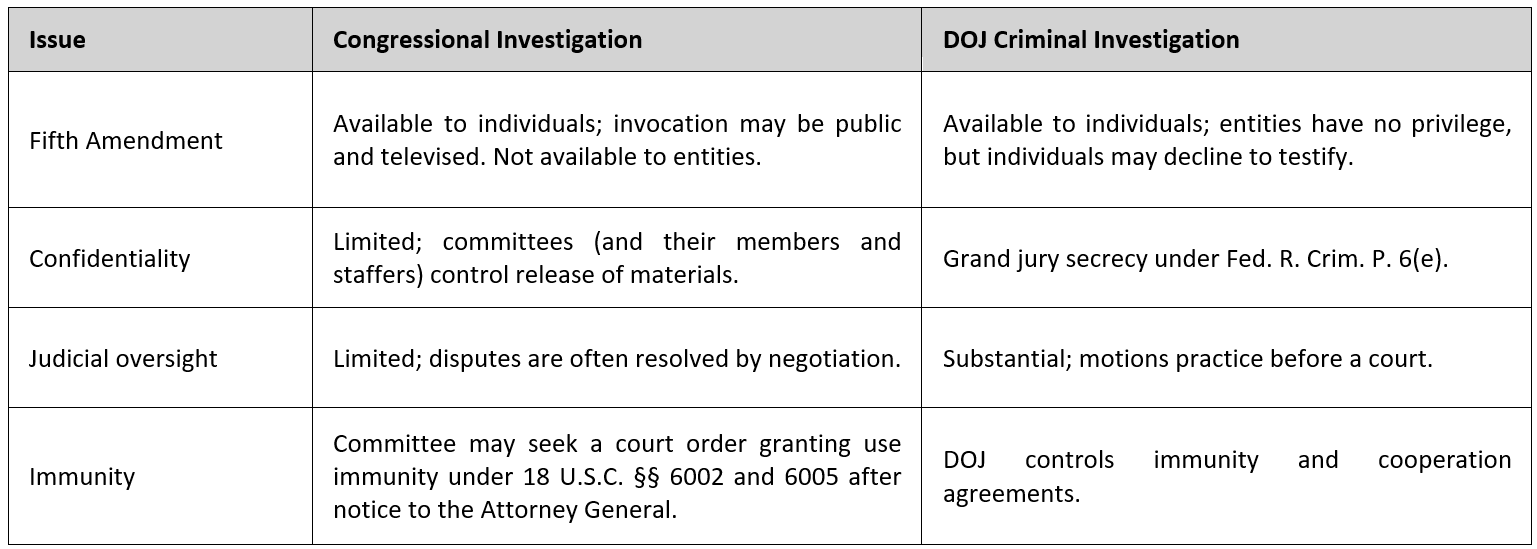
Key Differences Between a Congressional and Criminal Investigation
Practical Actions to Consider
- Consider issuing and enforcing a legal hold as soon as an inquiry appears likely. Preservation failures in a congressional inquiry can supply an independent obstruction allegation.
- Consider treating every submission as a potential criminal record. Vet written responses, briefings, and testimony for accuracy and completeness, and correct any misstatement promptly.
- Engage early on scope and protections. Committee staff will often negotiate the scope of requests, rolling productions, confidentiality, and the handling of privileged material.
- Protect privilege deliberately. Consider the consequences of waiving privilege in any production or testimony for subsequent DOJ, SEC, and civil proceedings.
- Evaluate individual witnesses separately. Assess whether employees need separate counsel, whether any witness should invoke the Fifth Amendment, and the reputational consequences of doing so publicly.
- Assess DOJ engagement strategy. Consider whether and when to approach DOJ, and how a congressional inquiry interacts with DOJ’s Corporate Enforcement and Voluntary Self-Disclosure Policy, cooperation credit, and any existing resolution obligations.
- Monitor for parallel civil and regulatory activity. Congressional inquiries frequently coincide with SEC, FTC, state attorney general, and private litigation, each of which may seek to obtain materials from a congressional investigation.
Key Takeaways
A congressional investigation is best managed as the possible first phase of a criminal case. Early, coordinated strategy on preservation, privilege, testimony, and DOJ engagement can significantly reduce exposure, and the most room to shape the outcome comes before the first letter arrives.
About Snell & Wilmer
Founded in 1938, Snell & Wilmer is a full-service business law firm with more than 550 attorneys practicing in 18 locations throughout the United States and in Mexico, including Phoenix and Tucson, Arizona; Los Angeles, Orange County, Palo Alto and San Diego, California; Denver, Colorado; Washington, D.C.; Boise, Idaho; Las Vegas and Reno-Tahoe, Nevada; Albuquerque, New Mexico; Portland, Oregon; Dallas, Texas; Salt Lake City, Utah; Seattle, Washington; and Los Cabos and Mexico City in Mexico. The firm represents clients ranging from large, publicly traded corporations to small businesses, individuals and entrepreneurs. For more information, visit swlaw.com.