Publication
California’s Next PFAS Targets Are Already Regulated in Minnesota and New Mexico: What DTSC’s 2027–2029 Work Plan Means for Multistate Compliance
Overview
The timing is notable. Within roughly sixty days, three states using three different regulatory models will each reach a milestone affecting many of the same products. Companies that sell nationally, and buyers evaluating them, should treat these regimes as one compliance problem rather than three.
On November 13, 2026, the California Department of Toxic Substances Control (DTSC) released a Discussion Draft of its Three-Year Priority Product Work Plan for 2027–2029 under the Safer Consumer Products (SCP) program. Several of the per- and polyfluoroalkyl substance (PFAS) product categories DTSC proposes to evaluate or regulate, including floor maintenance products and ski waxes, are already subject to reporting obligations or sales bans in Minnesota and New Mexico.1 DTSC will hold a public workshop on December 8, 2026, and written comments are due January 11, 2027.
Key Dates
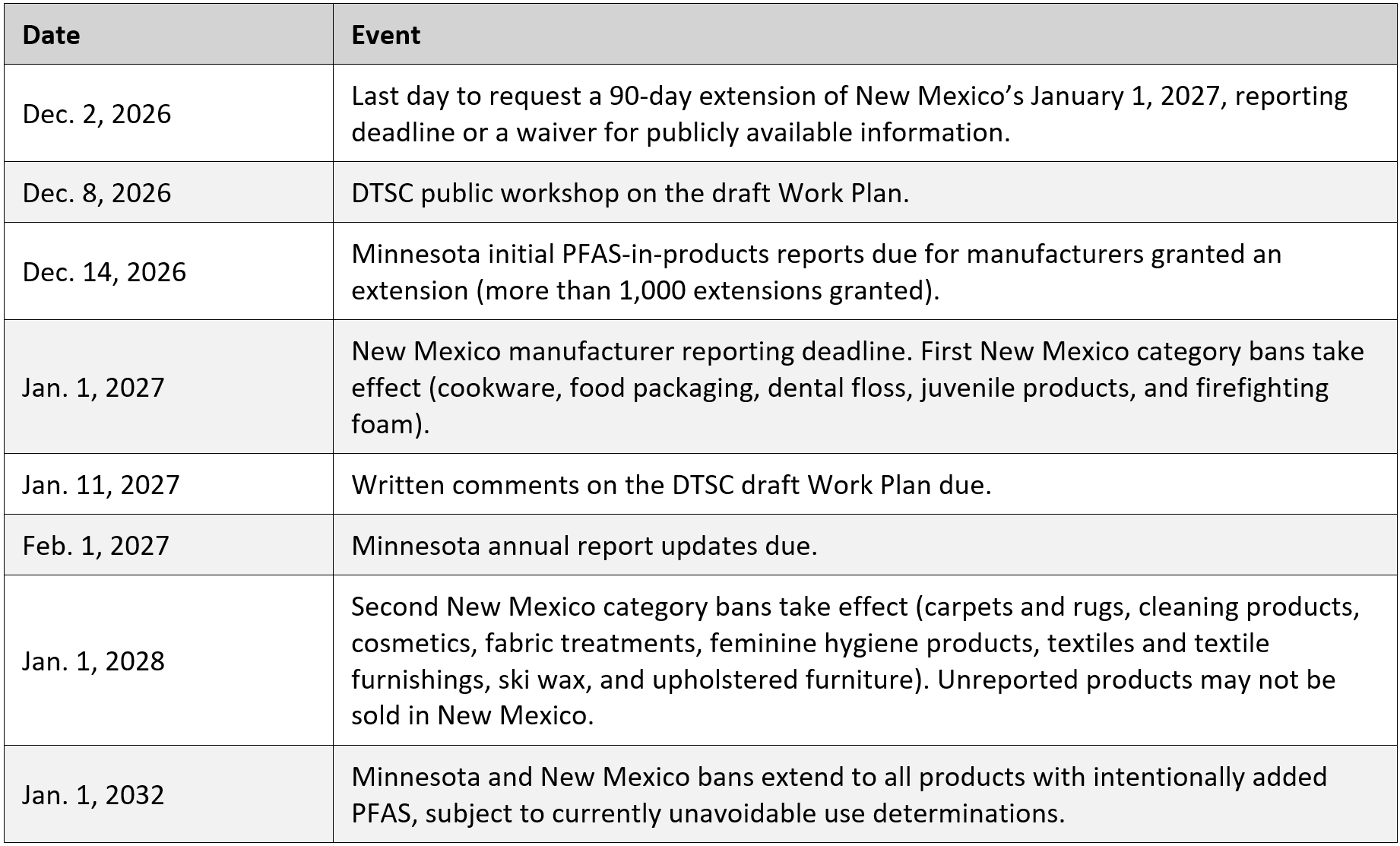
What the DTSC Draft Work Plan Does, and Does Not, Do
The Work Plan is not a PFAS disclosure rule or ban. By its own terms, it does not create regulatory requirements for any product or product category. Instead, it identifies the product categories DTSC intends to evaluate over the next three years and signals potential future Priority Products. A product-chemical combination becomes a Priority Product only when DTSC adds it to the Priority Products List by regulation, after which responsible entities (manufacturers, importers, assemblers, and retailers) must comply with the SCP regulations, including notification of DTSC and evaluation of safer alternatives.
California’s disclosure lever is targeted. DTSC states that it may require manufacturers to disclose information about their products and chemical ingredients under Health and Safety Code (HSC) section 25253.7, and that it intends to request information in a targeted manner as its research proceeds. This differs from the broad, upfront product reporting required in Minnesota and New Mexico.
The PFAS items in the draft include:
- Floor maintenance products containing PFAS: rulemaking to list as a Priority Product.
- Anti-fog products containing PFAS: release of a draft Product-Chemical Profile and rulemaking.
- Hard-surface sealers containing PFAS: release of a draft Product-Chemical Profile and rulemaking.
- Ski waxes containing PFAS: release of a draft Product-Chemical Profile and rulemaking.
- Textile and leather treatments containing PFAS: release of a compliance report.
- Artificial turf: additional information gathering and product testing to confirm whether PFAS have been removed; DTSC will proceed with regulation if PFAS remain. DTSC paused this work in February 2026 to confirm whether a pre-regulatory market shift had occurred.
DTSC also cites its October 2024 compliance report, which found that the Priority Product listing for carpets and rugs containing PFAS led to industry-wide abandonment of PFAS in those products. Because manufacturers reformulated rather than notify DTSC of continued use, the listing appears to have driven the market shift without any alternatives analysis being required. DTSC’s decision to pause its artificial turf work to confirm whether a “pre-regulatory market shift” has occurred suggests that even the prospect of a listing can have the same effect.
California’s Two Paths to PFAS Bans
California restricts PFAS in consumer products in two ways. The first is DTSC’s Safer Consumer Products program. Under it, DTSC has previously listed two PFAS Priority Products: carpets and rugs (effective July 1, 2021) and treatments for converted textiles or leathers (effective April 1, 2022). These listings are not bans. Instead, manufacturers must notify DTSC and then remove or replace the PFAS, withdraw the product from California, or prepare an alternatives analysis.
The second path is direct legislation, which has produced most of California’s outright PFAS bans: plant-fiber food packaging (HSC § 109000, ban effective January 1, 2023), juvenile products (HSC § 108945 et seq., ban effective July 1, 2023), textile articles (HSC § 108970 et seq., ban effective January 1, 2025) and cosmetics (HSC § 108981.5 et seq., ban effective January 1, 2025). The cosmetics ban prohibits any intentionally added PFAS and did not come from a DTSC listing. It builds on an earlier 2020 law that banned thirteen specified PFAS in cosmetics (HSC § 108980), also effective January 1, 2025.
The two tracks shape each other. DTSC may not duplicate or adopt conflicting regulations for product categories already regulated or subject to pending regulation, so legislation can displace a pending listing. After the Legislature banned PFAS in plant-fiber food packaging, DTSC dropped its proposed Priority Product listing as unnecessary. Legislative analyses cite the slow pace of the SCP process — DTSC has adopted only ten Priority Products since the program began in 2013 — and note that the SCP statute does not preclude direct legislative action. The Legislature has also made DTSC the enforcement agency for several of its bans.
In short, legislation can overtake a Work Plan listing, and DTSC research often supplies the record legislators rely on. Companies tracking the Work Plan should also monitor PFAS bills in the same product categories.
Takeaways
For product manufacturers
- Consider using Minnesota and New Mexico reporting data as a California readiness inventory. Products already reported in those states are the most likely subjects of a DTSC information request under HSC § 25253.7.
- Comment on the draft Work Plan by January 11, 2027. Companies with PFAS floor maintenance, anti-fog, sealer, or ski wax products should consider whether reformulation already underway supports narrower scoping; DTSC’s pause on artificial turf shows the agency will consider evidence of a market shift. Because the Legislature can bypass the Work Plan, as it did with food packaging, companies should also track PFAS bills covering the same categories.
- Evaluate whether supply contracts require component-level PFAS disclosure sufficient to support state reporting, particularly because Minnesota’s exclusion turns on the manufacture date of the final product.
For M&A transactions
- Diligence: Request copies of the target’s Minnesota and New Mexico PFAS reports, extension or waiver requests, and supplier certifications. Gaps may signal both state-law exposure and a future California compliance burden.
- Representations: Consider PFAS-specific representations covering intentionally added PFAS, timely state reporting, and the absence of agency information requests or notices.
- Compliance cost allocation: Where a target’s products fall within DTSC’s targeted categories or upcoming Minnesota and New Mexico bans, consider addressing reformulation or reporting costs through special indemnities, escrows, or purchase price adjustments.
Caveats
The DTSC Work Plan is a discussion draft, and its contents may change before it is finalized. This update reflects information available as of November 23, 2026.
Footnotes
-
On September 16, 2026, the U.S. District Court for the District of New Mexico preliminarily enjoined enforcement of New Mexico’s PFAS labeling requirement, 20.13.2.13 NMAC, on First Amendment compelled-speech grounds in American Chemistry Council v. Kenney, No. 1:26-cv-02130. As we discussed in our September 23, 2026 alert, the court found the label likely factual and uncontroversial but concluded that New Mexico had not shown it was sufficiently tailored to the State’s asserted interest. New Mexico filed a notice of appeal to the Tenth Circuit on October 16, 2026. The injunction does not reach the reporting obligation or the sales bans, which remain in force.
About Snell & Wilmer
Founded in 1938, Snell & Wilmer is a full-service business law firm with more than 550 attorneys practicing in 18 locations throughout the United States and in Mexico, including Phoenix and Tucson, Arizona; Los Angeles, Orange County, Palo Alto and San Diego, California; Denver, Colorado; Washington, D.C.; Boise, Idaho; Las Vegas and Reno-Tahoe, Nevada; Albuquerque, New Mexico; Portland, Oregon; Dallas, Texas; Salt Lake City, Utah; Seattle, Washington; and Los Cabos and Mexico City in Mexico. The firm represents clients ranging from large, publicly traded corporations to small businesses, individuals and entrepreneurs. For more information, visit swlaw.com.