Publication
Under Construction – February 2026
Letter From the Editor
Welcome to the winter edition of Snell & Wilmer’s Under Construction newsletter. We hope you enjoyed a joyful holiday season and a strong start to the new year.
This newsletter covers key legal developments and construction industry trends that may be relevant to you and your business. In this edition, we discuss amended Texas Legislature statutes impacting construction contracts and California legislation affecting the claims and dispute resolution process for change orders. We also provide insights on unbiased decision-making and the role it plays in dispute resolution and discuss affordable housing bills that recently passed in Colorado, as well as the role of ownership and licensing in design agreements. Finally, this edition includes a summary of lessons learned from the Ward v. Bishop decision, which provides guidance for contractors and construction attorneys navigating the Idaho Contractor Registration Act.
These articles are designed to inform and keep you ahead of developments. As always, we welcome your feedback and topic suggestions for future newsletters. We extend our best wishes for a successful and safe 2026 for you, your business, and your family.
Best Regards,
Timothy E. Reilly, Editor
Table of Contents
Texas Voids Out-of-State Forum and Choice of Law Clauses in Construction Contracts
The Texas Legislature amended statutes impacting construction contracts for projects located in Texas to declare any forum selection clause or choice of law provision “void as against public policy,” and mandate venue for any litigation or arbitration shall be in the Texas county in which the work is performed. The parties may stipulate to a different venue only after the dispute arises.
Forum selection clauses and choice of law provisions are common in construction contracts. Frequently, general contractors based in other jurisdictions require subcontractors to sign contracts designating the contractor’s preferred venue for any dispute. These contracts may also select the law of another state to govern the contract.
Many jurisdictions disfavor these clauses, and Texas has enacted two statutes addressing forum selection and choice of law provisions in construction contracts.
First, Section 15.020 of the Texas Civil Practice & Remedies Code permits contracting parties to select a particular county as venue for disputes involving “major transactions,” defined as written transactions involving consideration with an aggregate value equal to or greater than one million. The statute previously provided that venue provisions in construction contracts were “voidable” at the election of the party performing the work. Tex. Civ. Prac. & Rem. Code § 15.020 (d) (2).
Second, in 2007, the Texas Legislature enacted a statute specifically addressing forum selection and choice of law provisions in construction contracts and deeming such clauses “voidable” at the option of the contractor performing the work. Tex. Bus. & Com. Code § 272.001.
At least two Texas courts interpreted the previous version of this statute and held that the strong public policy favoring freedom of contract negated the contractor’s statutory ability in Section 272.001 to assert that the venue provision was “voidable.” See generally, America-Fab, LLC v. Vanguard Energy Partners, LLC, 646 F.Supp.3d 795, 805-06 (holding that “’Texas’s strong public policy favoring freedom of contract’ requires courts to ‘respect and enforce the terms of a contract the parties have freely and voluntarily entered’” and enforcing contractual venue clause in New Jersey instead of Texas); In re MVP Terminalling, LLC, 2022 WL 3592303, Tex.App.-Houston [14th Dist.] 2022 (not designated for publication) (holding parties may contractually waive rights to challenge forum selection clauses pursuant to Section 272.001).
These courts determined that contractors and subcontractors could still waive their ability to declare the choice of law or forum selection provisions as “voidable” by agreeing to a different state’s venue and/or law. “Weighed against the freedom of contract, the Texas Supreme Court has stated that ‘absent a Texas statute requiring suit to be brought in Texas, the existence of Texas statutory law in an area did not establish such Texas public policy as would negate a contractual forum-selection provision.’” America-Fab, LLC v. Vanguard Energy Partners, LLC, 646 F.Supp.3d 795, 805-06 (citing In re Lyon Fin. Servs. Inc., 257 S.W.3d 228, 234 (Tex. 2008) (emphasis original).
The United States District Court for the Southern District of Texas also interpreted the previous version of Section 272.001 and held that the Federal Arbitration Act preempted the statute for contracts containing an arbitration clause. See Glob. Indus. Contractors, LLC v. Red Eagle Pipeline, LLC, 617 F. Supp. 3d 633, 637-38 (S.D. Tex. 2022).
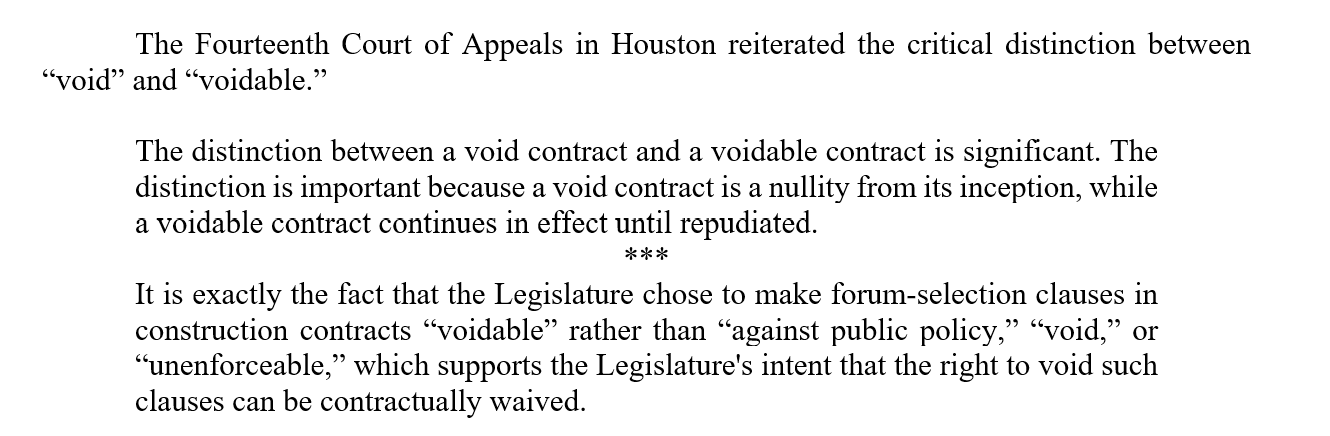
In re MVP Terminalling, LLC, 2022 WL 3592303 at *6-7, Tex.App.-Houston [14th Dist.] 2022 (not designated for publication) (internal citations omitted).
Section 15.020 of the Texas Civil Practice & Remedies Code and Section 272.001 of the Texas Business & Commerce Code now provide that any forum selection clause in a construction contract requiring venue for litigation or arbitration in another state or subjecting the contract to the law of another state is “void as against public policy.” Section 272.001 also now includes the following additional statutory prohibition for construction contracts:
(c) To the extent that a venue provision in a contract is void under Subsection (b), unless the parties stipulate to another venue after the dispute arises, an action arising out of the contract shall be brought only in this state in the county in which the property that is the subject of the litigation is located.
Tex. Bus. & Com. Code § 272.001 (emphasis added).
These amendments took effect on September 1, 2025, and only apply to contracts entered into or renewed on or after that date. Texas courts have not yet interpreted these recent statutory amendments, nor has a court determined whether the Federal Arbitration Act preempts these statutory prohibitions. Contractors performing work in Texas should be aware of this critical new framework when negotiating contracts for work performed in Texas.
California Enacts Change Order Fair Payment Act
For private works construction contracts entered on or after January 1, 2026, recent legislation establishes a claims and dispute resolution process for change orders. The law is codified at Civil Code § 8850. A synopsis of the pertinent provisions includes the following:
1. Submitting a Claim. Contractors or subcontractors must submit a detailed, documented claim when requesting additional time or payment.
2. Owner’s Response Time. The owner must meet and confer within thirty (30) days after receiving the claim. Within ten (10) days of meeting, the owner must provide a written statement identifying which portions of the claim are undisputed and which are disputed. An owner’s failure to respond is treated as disputing the entire claim.
3. Payment and Penalties. The owner must pay any undisputed portion within sixty (60) days after issuing its written response statement. If undisputed amounts are not paid timely then a penalty of two percent (2%) per month (twenty-four percent (24%) annually) applies, including to amounts later determined to be owed following dispute resolution. If any portion of the claim remains disputed after meet and confer, the parties must participate in nonbinding mediation before proceeding to arbitration or litigation, and they must share mediation costs equally.
4. Stop Work Option. If the owner ignores the timelines or refuses to mediate, the contractor may issue a stop work notice and suspend its work forty (40) days after providing that notice.
5. Contractual Waiver. The requirements of Civil Code § 8850 cannot be waived by contract.
Both owners and contractors engaged in private works construction should ensure their teams are aware of this new law and be prepared to comply with its procedures. If you are using a form contract, review it to confirm the dispute resolution and claims provisions align with the law for contracts entered on or after January 1, 2026. You may negotiate reasonable additional claims requirements so long as they do not conflict with the procedures set forth in Civil Code § 8850.
Leaders in Dispute Resolution Need to Make Unbiased Decisions for Mediation to Succeed
As a mediator helping to settle construction disputes and as an arbitrator deciding outcomes of these disputes, I found certain lessons to be especially helpful after graduating last summer from the Executive Education program at Harvard Kennedy School (HKS). The exceptional HKS curriculum included courses focused on negotiation strategies for multiparty disputes, decisive leadership during crisis, and human behavior affecting dispute resolution.
In particular, our HKS class debated the impact of cognitive bias in dispute resolution, and we studied a central theme that decision-making is universally scientific. That is, parties making decisions in dispute resolution exhibit and rely upon empirical factors that good mediators and decision makers should appreciate and understand. Bias, for example, can cause key players to discount persuasive witnesses, admissible evidence, and reliable expert opinions that influence the outcome of a construction dispute. Biased decision makers may also choose to withhold key information from the mediator, as though doing so will help rather than hurt what is supposed to be an objective and diplomatic process.
In the heat of dispute resolution, biases may also hinder sound decision-making before, during, and after mediation of the dispute. Mediators must recognize the risk of “bad cues,” such as personal feelings of incidental anger, and then refocus decision makers on both favorable and unfavorable facts, mitigating information, and undisputed issues. Replacing a decision maker’s anger or bias with a simple acknowledgment of the risk of losing the dispute may be all it takes to identify meaningful opportunities to compromise and settle.
The point is not merely to recognize obvious factors impacting the negotiations but to understand how they inevitably affect mediation and how those same factors will contribute to the outcome if mediation fails. Construction disputes often involve millions of dollars in claims and years of stubborn discontent between parties that become exhausted by the contest and fees and costs required to seize any advantage. Dispute resolution often costs far more than the value of the parties’ claims, and this dilemma often causes parties to mediate with highly unreasonable expectations. Human behavior tends to be at its worst under these extreme circumstances. Some scholars even suggest that psychiatrists would make better mediators than lawyers.
To be sure, the best construction mediators have a strong grasp of every factor shaping the dispute — psychological, scientific, and legal. Party representatives in construction mediation often — sometimes unwittingly, allow their biases to dictate uncompromising terms, as though refusing to compromise early will ultimately force more acceptable terms of compromise later. A good mediator should be prepared to break down these barriers before mediation begins. The mediator also needs to earn the decision maker’s trust by demonstrating an understanding of the parties’ biases and by persuading leaders to leave those biases out of the negotiations.
Surveys conclude that mediation succeeds most of the time. Nonetheless, mediation has the best chance of success when decision-makers are willing to acknowledge their biases but agree that they should not bring those biases to the mediation.
***Opinions expressed are those of the author and not necessarily the firm’s or their colleagues’.
Colorado Legislature Considers Series of Bills Aimed at Boosting Affordable Housing Construction in Colorado — What Homebuilders Need to Know
On January 21, 2026, lawmakers introduced a series of bills with the goals of addressing affordable housing issues and incentivizing construction in Colorado.
House Bill 26-1001 (known as the “Housing Opportunities Made Easier ‘HOME’ Act”) concerns the promotion for residential developments on “qualifying properties” that do not contain exempt parcels through the bypassing of often time-consuming local planning processes. Under HB26-1001, a “qualifying property is any real property that contains no more than five acres of land and is owned by: (i) a nonprofit organization with a demonstrated history of providing affordable housing; (ii) a nonprofit organization that provides public transit; (iii) a nonprofit organization that has entered into an agreement with another nonprofit organization with a demonstrated history of providing affordable housing, provided that the agreement requires the nonprofit organization with a demonstrated history of providing affordable housing to develop a residential development on the property; (iv) a school district; (v) a state college or university; (vi) a housing authority; or (vii) a local or regional transit district or a regional transportation authority serving one or more counties.
House Bill 26-1065 would create a funding mechanism for local governments to pay for projects aimed at increasing transit use. There appears to be two primary sections of this bill. Section 2 of this bill creates the “Transit Area Investment Act,” which creates a mechanism for local government and transit agencies to initiate and undertake an investment project to develop qualified low- and middle-income housing within “transit and housing investment zones” (within one and one-half miles from a transit hub). It allows the commission to approve no more than three transit investment projects in any calendar year and no more than six in total. It further allows for up to $75 million per fiscal year to be allocated to approved transit investment projects. The next section, Section 9 of this bill, creates a new tax credit known as the “Colorado Affordable Housing in Transit Investment Zones Tax Credit” for qualified low- and middle-income housing projects built within “transit and housing investment zones” and would allow local governments to use tax-increment financing to fund transit and transportation projects within these zones. The bill would also allow $50 million of credits to be awarded each calendar year beginning in the 2027 calendar year through the 2033 calendar year.
House Bill 26-1066 addresses affordable rental properties and concerns the expansion of property tax exemptions (currently available to property acquired and developed for low-income housing by nonprofit housing providers, community land trusts, and nonprofit affordable homeownership developers) to include development of low-income rental properties.
Proponents of these bills believe they will incentivize construction by streamlining the development process on vacant land and by providing funding for housing near transit stations. Critics, however, argue that they undermine the local planning processes, allowing certain groups to bypass rules and initiate construction without community input, and could result in unintended consequences due to lack of proper planning protocols.
On February 3, 2026, the House Transportation, Housing and Local Government Committee voted on and passed HB26-1001, recommending it for further consideration. HB26-1065 and HB26-1066 have not yet been scheduled for their first hearings. Colorado construction professionals should continue to monitor these bills and further legislative action and, in the meantime, develop strategies with their construction attorney with regard to these proposed changes.
Ownership and Licensing in Design Agreements
By Abby Dvorkin
The ownership and licensing of design documents in professional services agreements play a significant role in protecting the interests of the design professional and the project owner during and after project completion. The ownership or licensing of the drawings provision typically outlines who owns the drawings and specifications, who can use the documents, and how the documents can be used during and after the project.
Project owners and developers should understand that payment for design services does not automatically transfer ownership or an exclusive right to use the professional design. Under U.S. copyright law, the default rule is that the design professional retains ownership of the instruments of service absent a contractual provision transferring ownership or a license. See 17 U.S.C. § 101, et seq. The Architectural Works Copyright Protection Act provides that copyright protection applies to “pictorial, graphic and sculptural works” and includes “architectural works.” 17 U.S.C. § 102. A design professional may only transfer copyright ownership in writing. 17 U.S.C. § 204(a).
Without a contract addressing the parties’ intellectual property rights, the parties risk disputes regarding the use or reuse of the design, modification of the documents, completion of the project after termination, disputes over payment, and responsibility for errors or changes made by others. Thoughtful negotiation of these provisions can help avoid costly disputes. Below are important considerations for both parties when evaluating the copyrights and licensing clause.
Considerations for Project Owners
Project owners should evaluate the rights to the design that they will need to successfully complete, operate, and maintain the project. The project owner should consider:
1. Scope of Use. Some agreements limit the owner’s right to use the design documents to the specific project through a non-exclusive license, while others transfer copyright ownership of the design documents, often conditioned on events such as full payment for the services. The project owner’s considerations include whether it intends to use the design documents solely for the project, for future projects, or for additional phases of the project and evaluate which option will meet the owner’s needs.
2. Termination Rights. If the agreement is terminated, or if the design professional’s scope of work is limited to certain phases, the owner may need to continue to use the design documents to complete the design or construction. The parties should consider options that allow the owner to complete the project in a timely manner.
3. Reuse and Modification of the Design. If the owner anticipates using the design for additional phases or for similar projects, the agreement should either provide the owner with ownership of the design documents so the owner can use them as needed or grant a license permitting reuse of the design documents.
4. Risk Allocation for Reuse. If design documents are modified, reused for other projects, or used for purposes outside of the scope of the agreement, agreements often shift the risk to the owner.
Considerations for Architects and Other Design Professionals
1. Ownership versus License. Design professionals must decide whether to retain ownership of their designs and grant a limited license to the owner to use the designs for the project, or transfer ownership of the designs to the owner. Retaining ownership sets limits on future use by the owner without the design professional’s involvement and helps protect design professionals’ proprietary designs as well as the right to reuse their own designs.
2. Owner’s Reuse of the Design. The design professional should recognize that reuse of the design on other projects can expose the design professional to claims arising from modifications by others outside of the design professional’s control. To help prevent liability for errors made by others outside of the design professional’s control, design professionals often require indemnification against claims arising from modifications made by others for which the design professional was not involved.
3. Payment Conditions. Design professionals often condition a license or the transfer of ownership upon payment from the owner.
4. Prior Designs. When using designs by other design professionals, the design professional should confirm that the owner has granted permission for the design professional to use the design documents provided.
5. Subconsultants. Design professionals should not overlook their agreements with their subconsultants and should ensure those subconsultants grant them the right to use the subconsultants’ documents in the same manner the design professional agrees to provide to the owner.
The major industry form agreements including those from the American Institute of Architects (AIA), Design-Build Institute of America (DBIA), ConsensusDocs, and Engineers Joint Contract Documents Committee (EJCDC) address copyright and licensing in different ways, and the parties should understand the legal and practical implications of the clauses. These provisions can be customized to better align with the parties’ goals and objectives.
Idaho Contractor Registration: Lessons from the Ward v. Bishop Decision
The Idaho Supreme Court’s recent decision in Ward v. Bishop Constr., Ltd. Liab. Co., No. 51118, 2025 Ida. LEXIS 143 (Dec. 31, 2025) offers valuable guidance for contractors and construction attorneys navigating the Idaho Contractor Registration Act (ICRA). The December 2025 ruling clarifies critical questions about when and how defendants may raise contractor registration defenses, the weight of pretrial stipulations, and the consequences of procedural missteps in construction litigation. This article examines the key takeaways from the decision and offers practical actions for consideration by those working in Idaho’s construction industry.
The Facts Behind the Dispute
The case arose from a long-standing working relationship between cousins Joel Ward and Ren Bishop dating to the 1990s. Ward performed general construction work for Bishop Construction, LLC, including building, plumbing, electrical, framing, roofing, and siding work on projects in Idaho, Montana, and Wyoming. Bishop agreed to pay Ward $10 per hour, later increased to $12 per hour, plus one-way travel expenses. Between 2017 and 2019, Ward worked over 1,100 hours but was never paid, totaling $12,443.54 in claimed damages.
Ward initially filed suit alleging violations of the Fair Labor Standards Act and Idaho wage laws. Before trial, Ward’s counsel offered to stipulate that Ward was an independent contractor rather than an employee, which would eliminate the wage claims and leave only breach of contract and unjust enrichment claims. Bishop agreed to this stipulation, and the district court accepted it. Following a bench trial where Ward was the only witness, the court found in Ward’s favor and awarded the full amount claimed.
The critical procedural misstep occurred after the verdict. Bishop failed to raise any defenses under the ICRA during trial. Only after Ward moved for attorney fees did Bishop argue – for the first time – that the contract was illegal because Ward was not registered as a contractor under ICRA. The district court initially modified its judgment, finding the contract illegal for Idaho work but allowing recovery for out-of-state work, plus unjust enrichment damages for Idaho work.
Understanding ICRA’s Requirements
The ICRA establishes broad requirements that every construction professional must understand. ICRA defines a “contractor” as any person who undertakes, offers to undertake, purports to have the capacity to undertake, or submits a bid to perform construction work, whether done personally or through others. Idaho Code § 54-5203. The Act makes it unlawful for any person to engage in contracting business within Idaho without proper registration. Idaho Code § 54-5204.
The consequences of noncompliance are severe. Unregistered contractors cannot bring or maintain any action in any court of this state for the collection of compensation for the performance of any act or contract for which registration is required. Idaho Code § 54-5217. Furthermore, contracts for construction work subject to ICRA are invalid if the contractor is unregistered at the time of execution. In that circumstance, the consideration consists of an act contrary to law and public policy. The Idaho Supreme Court has also made clear that subsequent registration does not validate an illegal contract. As prior decisions explain, when the legislature enacted ICRA, it took the extraordinary step of expressly stripping the economic protections typically extended to unregistered contractors.
The Supreme Court’s Analysis
The Idaho Supreme Court’s decision centered on two critical issues: the burden of proof for affirmative defenses and the scope of pretrial stipulations. On the first issue, the Court emphasized that defendants bear the burden of proving affirmative defenses, including illegality under ICRA. The Court noted that it was Bishop’s burden, as the party asserting ICRA as an affirmative defense, to establish such proof. This aligns with established Idaho law that once a plaintiff proves the existence of a contract and its breach, the defendant has the burden of pleading and proving affirmative defenses which legally excuse performance.
Bishop’s failure to present evidence during trial regarding Ward’s contractor status under ICRA proved fatal to his defense. The Court emphasized that although illegality can be raised at any time, applying this principle here was erroneous because no evidentiary foundation had been laid.
The Court’s treatment of the pretrial stipulation provides equally important guidance. The stipulation that Ward was an independent contractor was made solely to eliminate wage claims and streamline the trial. The Court held that stipulations of parties or counsel made in pending proceedings are conclusive as to matters properly included, but the Court emphasized that ICRA was not encompassed by the stipulation. The Court found the stipulation woefully inadequate to establish that Ward was a contractor under ICRA. Critically, ICRA’s registration requirements were not identified as an issue to be tried when the stipulation was offered.
Practical Takeaways for Idaho Construction Professionals
The Ward v. Bishop decision offers several lessons that contractors and construction attorneys should consider incorporating into their practices. First, parties defending against claims by potentially unregistered contractors should investigate and raise ICRA compliance issues during discovery and present evidence at trial. While contract illegality can theoretically be raised at any time, defendants who fail to present supporting evidence during dispositive motion practice or trial may find their defenses unsuccessful.
Second, attorneys should consider drafting stipulations with precision, carefully defining the scope and language of any agreements, particularly when they might intersect with statutory registration requirements. A stipulation regarding employment status for wage claim purposes may not necessarily establish contractor status under ICRA.
Third, for construction attorneys advising clients, the decision reinforces the importance of ICRA compliance verification. The Act requires contractors to verify the registration status of other contractors before engaging them. Failure to do so can result in complications, as demonstrated by the district court’s initial consideration of Bishop’s own failure to verify Ward’s registration status. See Idaho Code § 54-5204.
Construction law attorneys should consider implementing several best practices based on this decision. Early ICRA analysis is essential, meaning registration status should be investigated during initial case evaluation and discovery, not as an afterthought during post-trial motion practice, fee disputes or on appeal. When asserting ICRA defenses, counsel must develop a complete evidentiary record regarding the contractor’s activities, business operations, and registration status. Attorneys should also advise contractor clients to implement systems for verifying subcontractor and independent contractor registration status before engagement. Finally, contractors should maintain clear records distinguishing between employee and independent contractor relationships, as confusion can complicate ICRA analysis.
Conclusion
Ward v. Bishop clarifies that while ICRA provides powerful defenses against unregistered contractors, defendants must properly develop and present these defenses with supporting evidence. The decision emphasizes the importance of precise stipulation drafting and early identification of registration issues in construction disputes. For Idaho construction law practitioners and their contractor clients, this case serves as both a cautionary tale about procedural pitfalls and a roadmap for effective ICRA compliance and litigation strategy.
About Snell & Wilmer
Founded in 1938, Snell & Wilmer is a full-service business law firm with more than 500 attorneys practicing in 17 locations throughout the United States and in Mexico, including Phoenix and Tucson, Arizona; Los Angeles, Orange County, Palo Alto and San Diego, California; Denver, Colorado; Washington, D.C.; Boise, Idaho; Las Vegas and Reno-Tahoe, Nevada; Albuquerque, New Mexico; Portland, Oregon; Dallas, Texas; Salt Lake City, Utah; Seattle, Washington; and Los Cabos, Mexico. The firm represents clients ranging from large, publicly traded corporations to small businesses, individuals and entrepreneurs. For more information, visit swlaw.com.